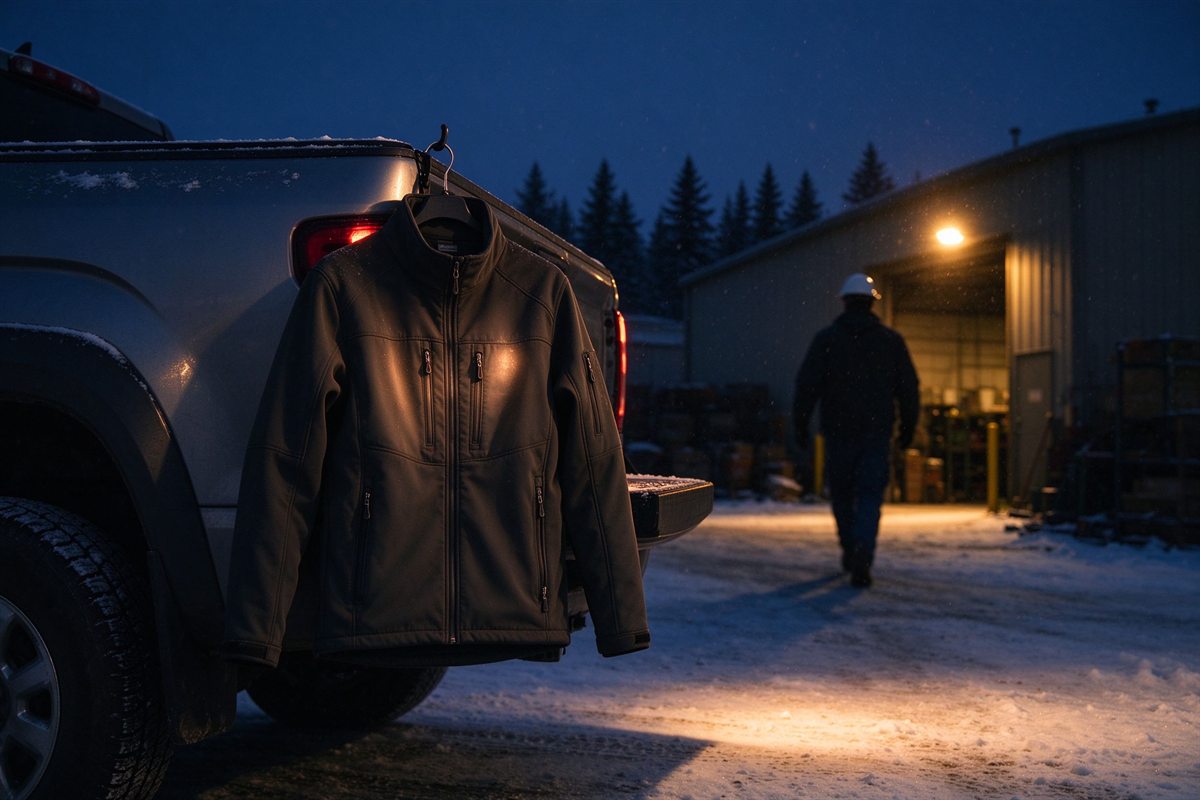
One heating system, four channels
The hardware does not change much between channels: element, pack, switch, connector. What changes is which of those things the buyer will test, which failure they will refuse to forgive, and what they are willing to pay to avoid it.
Most heated programmes that underperform are not badly made. They are correctly made for a channel they were never sold into.
Winter sports retail
This buyer cares about weight, packability and how the garment looks on a shelf next to established brands. Heat is a feature to demonstrate, not the reason for the purchase — the customer has already decided to buy a jacket, and the heated option is a trade-up.
That puts colourways, size runs, hangtag copy and a demo the staff can perform in ten seconds ahead of zone count. A retailer will also want to know how the garment behaves when the pack is not attached, because most units will be sold as apparel first.
Workwear and industrial
This buyer cares about durability, switch access through gloves, wash cycles, and whether the pack survives a shift in freezing conditions. Documentation and replacement-part availability close the deal; a purchase order usually follows a trial, not a catalogue.
The requirements are unforgiving in ways that are easy to miss: a switch that cannot be operated with a glove on makes the product unusable in the weather it was bought for, and a pack that lives in an unheated cab overnight has to be specified for it. High-visibility versions, if the channel is construction or utilities, often decide the specification before the heating system does.
Outdoor specialty, fishing and hunting
Long static sessions in the cold — ice fishing, hunting, sitting in a blind — reward heat that lasts and lands where the body loses warmth fastest. Runtime at low temperature matters more than styling, and the customer will notice immediately if the third hour is colder than the first.
Quiet fabrics, muted colourways and pocket layout carry weight here, and so does honesty about runtime. A product that claims a full day and delivers three hours loses the channel faster than a product that claims three hours.
Home, gift and camp comfort
Heated blankets, seat pads and folding chairs are the same technology with a lower technical bar and a shorter buying decision. The customer is often buying comfort rather than performance, and packaging — how it looks under a tree or on a marketplace listing — matters as much as the element.
For a brand already selling apparel, these are the easiest upsell: the specification work is smaller, the seasonal window overlaps, and the same carton and forwarder can carry both.
The private-label opportunity
Retailers with an existing cold-weather range often want a heated line without developing one. A supplier who builds to their labels, packaging and size grading hands them a seasonal product with no engineering risk on their side — which is exactly why private label is the fastest route into this category.
The reverse is also true. A factory that only offers a catalogue product with its own branding is asking the retailer to adopt someone else's design, and that conversation rarely survives the buying meeting.
Choosing your first channel
Pick the channel you already sell into. A heating system can be adapted to a channel more easily than a channel can be changed afterwards — the distribution, the buyer's language and the returns process are all harder to acquire than a different element layout.
If you sell into none of them yet, the second-best answer is the channel with the shortest proof cycle: workwear buys after a trial unit, outdoor specialty buys after a season of testing, retail buys after a line review. The trial single unit is the cheapest experiment in this category.
Signals a channel is ready for heated product
- The customer already buys a cold-weather product from you — the heated version can sit beside it rather than create a new category.
- There is a documented complaint about cold hands, cold feet or cold backs that the current range does not solve.
- Someone in the channel has already tried a competitor's heated product, which means the category is understood and the argument is about quality, not concept.
- You can support it after the sale: battery replacement, spare parts, a returns path. Product that cannot be serviced becomes a review problem.
Heated gear is sold on trust — that the warmth lasts, that the pack survives, that the label is honest. Choosing the right channel is mostly choosing where that trust is easiest to establish.