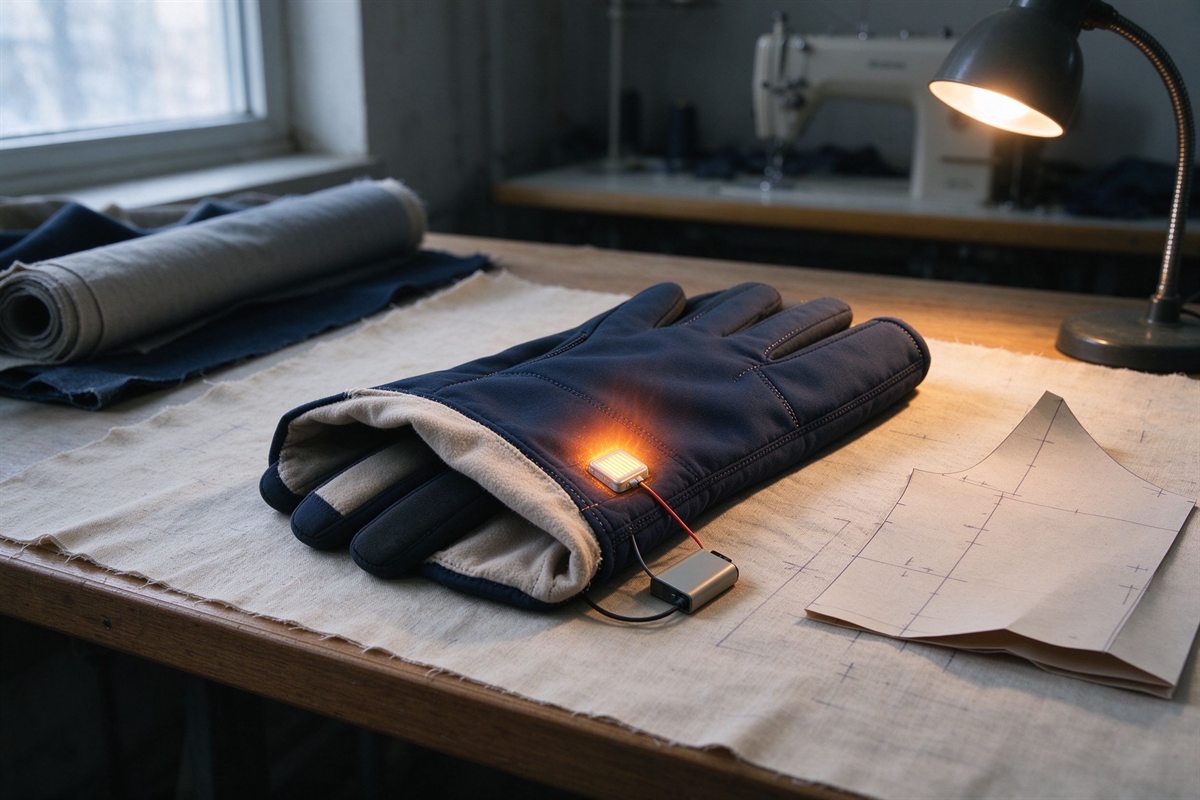
Why accessories are harder than jackets
A jacket has room. A glove does not. Every component — element, harness, switch, pack, connector — competes for the same few square centimetres, and all of it has to survive a hand that flexes hundreds of times a day and a wash cycle that a jacket would barely notice.
The consequences are specific: a heating element placed across the palm interferes with grip; a battery in the cuff changes the fit at the wrist; a switch that cannot be reached through a glove makes the product useless in the weather it was bought for. None of these show up in a specification document. They show up on a hand.
Step 1: the brief
Product type, target market, selling-price band, volume expectation, and any certification that market requires. The price band matters as much as the specification, because it decides wire versus carbon fiber, pack capacity, and packaging level long before the first pattern is cut.
A brief that names only the product type is not a brief. It is a request to guess, and the guess will be made differently by each supplier you ask.
Step 2: specification lock
Fabric, lining, heating zones, switch position, battery placement, sizing and labelling, all fixed in writing before sampling. Most revisions happen here, and this is the cheapest place to make them — a change at this stage is a change to a document; the same change after sampling is a new sample.
Locking the specification is also the point where the battery decision has to be final. A pack chosen later forces the harness, the cuff pocket and possibly the element layout to be redone.
Step 3: the sample
A physical sample is the only way to judge fit, switch reach, heat distribution and the weight in the pocket. Wear it, test it in the cold, and mark what changes on the sample itself rather than writing it down from memory afterwards.
Test it the way the customer will use it: with a glove on, at the temperature the product is sold for, for longer than a minute. Warmth that feels convincing at room temperature is not the same thing as warmth that holds on a chairlift or a night shift.
Step 4: revision and sign-off
One revision round is normal. The goal is a signed sample that becomes the production reference — an approved physical object, not a description of one. Keep photographs and a measurement sheet with the signature, because the sample that bulk production is measured against needs to survive being shipped around and worn.
If a second revision is needed, it is usually because something was left ambiguous at specification lock, not because the factory misunderstood. Ask which ambiguity it was; the answer usually shortens the next round.
Step 5: bulk and inspection
Production runs against the signed sample, with packing and labelling agreed in advance. Inspection before shipment should compare against that same sample rather than against a drawing, because a drawing cannot show how a cuff sits or how a switch feels through a glove.
Battery documents travel with the shipment — the pack inside the bulk order is the pack the paperwork must describe, and that is checked when the shipment is booked, not when it reaches a forwarder.
Where programmes lose time
Almost never in production. Programmes lose weeks in four places: the battery is chosen after sampling; colourways change once the sample is approved; labelling and packaging are decided at the last minute; and approval waits on someone who has not physically held the sample.
The fix is not speed. It is sequence — decide the things that force rework before you start building.
What a signed sample should contain
- The physical reference itself, in the exact fabric, colour and size that will be produced.
- The battery and connector that will ship, not a stand-in of similar capacity.
- The label set: care label, size label, any certification marking required by the destination market.
- A measurement sheet and photographs, so inspection has a written reference alongside the physical one.
- Written confirmation of packaging and carton configuration, since both affect the shipping cost quoted later.
The sequence is the same for jackets, pants and accessories; only the number of components changes. If you need to compress the calendar, compress sampling rather than specification — the specification is what bulk production is measured against.