Why the zone count is the least useful number on the sheet
A zone is a circuit, not an area. Two garments can both claim three heating zones and still differ several times over in how much surface actually gets warm. One may run three broad panels across the back and chest; another may run three narrow strips and call it the same thing.
What decides whether the wearer feels warm is the heated area, where that area sits relative to the places the body loses heat fastest, and how much power each zone draws at each level. Zone count tells you none of that. It is a marketing number that survived because it is easy to print on a hangtag.
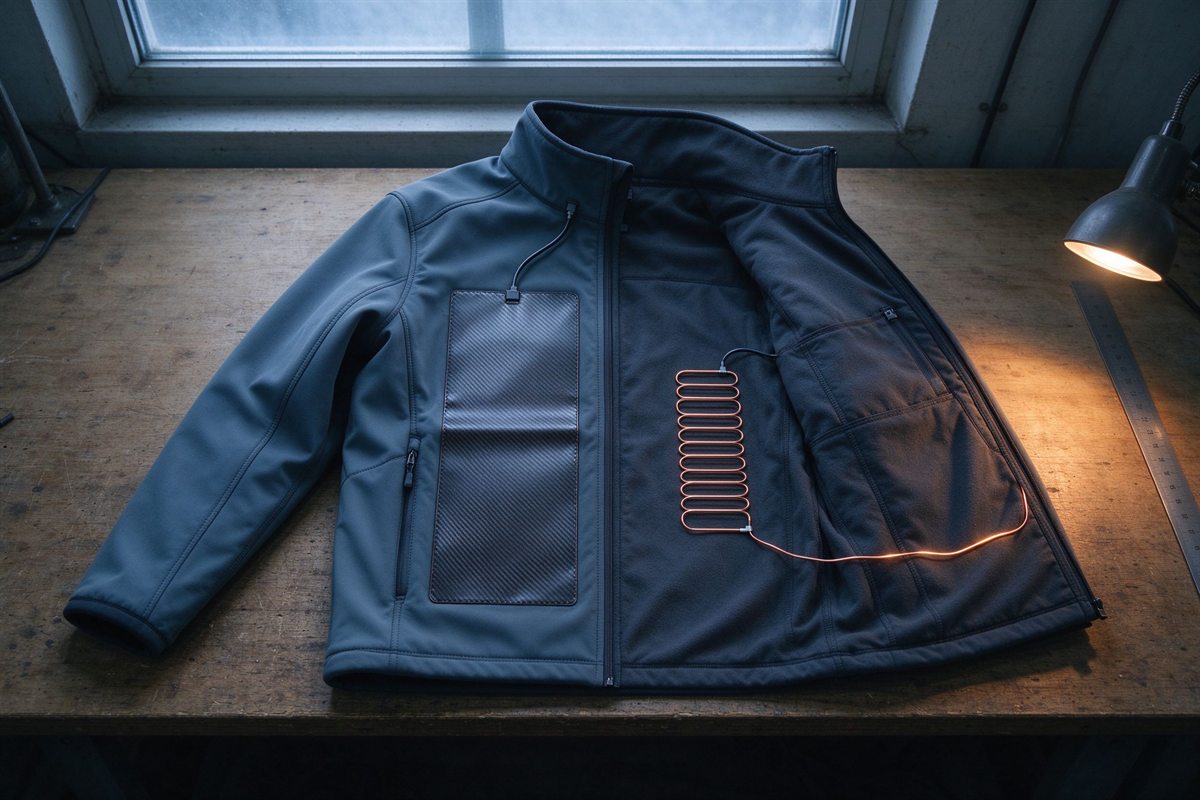
Wire elements: proven, inexpensive, and shaped like a line
A conventional heating element is a resistance wire, coated and stitched into a channel between shell and lining. It is inexpensive, widely available, and thoroughly understood by any factory that already makes heated products. That maturity is worth something: sourcing is predictable and a second production run behaves like the first.
The limitation is geometric. A wire heats along its path, so the fabric directly over the wire runs warmer than the gaps between channels. On a cold day that reads as stripes of warmth rather than a warm back. The wire also has to be routed clear of the places a garment folds, sits and bends — elbows, the seat, the collar roll — which constrains where you can put it without creating a wear point.
Carbon-fiber film: a surface instead of a line
Carbon-fiber heating film spreads heat across an area rather than along a path. That is why jackets built this way feel warm over the whole back instead of along a strip, and why the warmth decays gently toward the panel edge instead of stopping at a seam.
The film is also thin. It interferes less with drape and fit, and it tolerates flexing better at shoulders and collars, where wire channels tend to fatigue first. What it costs is money and design attention: the panel layout has to be developed around the pattern — cut, bonded and positioned during pattern development — rather than added to a finished garment afterwards.
What the difference does to production
On the factory floor the two technologies behave like different products. Wire is easier to add to an existing style: the channels are stitched, the harness is routed, and the pattern barely changes. Carbon film adds a bonding step and a lamination check, and defect risk moves from stitching to adhesion — a badly bonded panel shows up as a cold patch, not a visible fault.
That is why the two rarely land at the same price, and why a quotation should say which step was added, where the process risk sits, and what happens when a zone fails: is the panel replaceable, or is the garment written off? A supplier who can answer that has built the product before.
Three questions that separate suppliers
These are the questions worth asking before price, because they tell you whether the person quoting understands what they are quoting:
- Heated area in square centimetres per zone — and where the elements sit relative to the lining seams. A supplier who only has a zone count has not thought about the wearer.
- Strain relief at the collar and hem. The cable is the part that fails first. Ask how it is anchored, how the connector is sealed, and how the harness survives being pulled through a sleeve.
- How the garment is washed. With the battery and cable removed and the connector sealed, what does the care label actually say, and how does the panel tolerate flexing in a drum?
Which one to choose
Where cost drives volume — promotional ranges, short winter seasons, first-time heated buyers testing the category — wire is honest and works. The wearer gets real warmth, the price stays where the channel needs it, and the sourcing risk is low.
Where the wearer will notice where the warmth lands — premium outdoor, long workwear shifts, thin garments where a wire channel would be felt through the lining — carbon fiber earns its price. The same logic applies to accessories: a heated glove has almost no room to hide a channel, which is why film tends to win there.
We build both, and we will tell you which one your brief actually needs rather than which one is easier to quote.